
- LipoOrganiSil™
The Science of Liposomal Silicon
Why silicon matters, why most forms fail to deliver, and how mesoporous silica becomes the bioavailable OSA the body can actually use.
- Home
- The Science of LipoOrganiSil™
- Silicon's role in the body
An essential element for structural tissue
Silicon (Si) contributes to the synthesis of collagen — the scaffold that supports tissue — and elastin, which gives skin, hair and blood vessels their elasticity. Human studies have associated dietary silicon with stronger bones, improved skin roughness, hair strength, and reduced nail brittleness. It is generally well-tolerated, with no significant toxicity reported at typical supplement doses.
- Skin, hair & nails
- Bones & cartilage
- Tendons & joints
- Blood vessels & connective tissue

- The instability problem
OSA will not hold its shape
Orthosilicic acid (OSA) is the only bioavailable form of silicon — and without stabilization it readily polymerizes into insoluble aggregates, losing the very bioavailability that makes it valuable. Even monomethylsilanetriol (MMST), a stable synthetic precursor, polymerizes in water unless conditions are strictly monitored. Any credible silicon ingredient must ensure stability, not just absorption.
SiO₂ + 2H₂O ⇄ Si(OH)₄
Hydrolysis of silica to bioavailable OSA; more pronounced in neutral-to-alkaline intestinal conditions than in the acidic stomach.
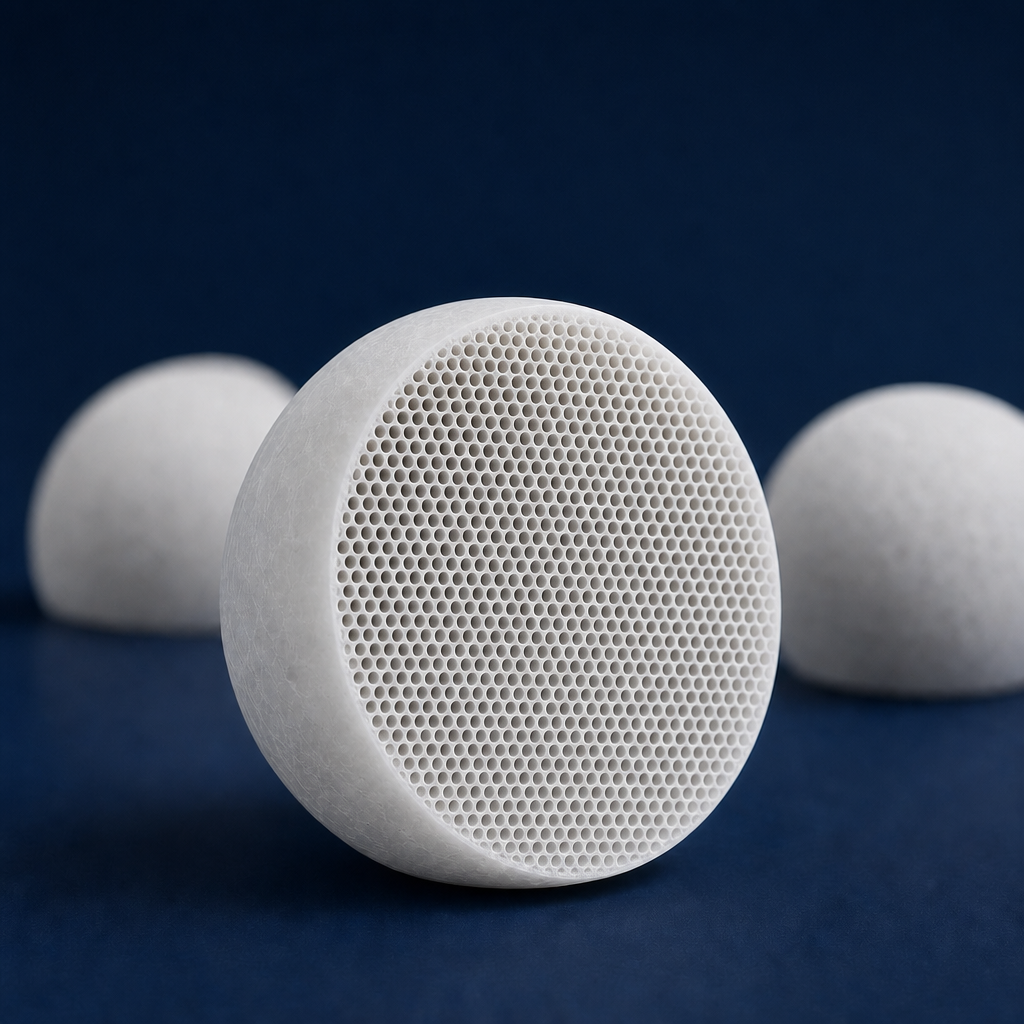
Illustrative rendering — mesoporous silica nanoparticle (cross-section).
Pore scale exaggerated for clarity.
- The active ingredient
Engineered pores that convert on cue
The active ingredient in LipoOrganiSil™ is a Mesoporous Silica Nanoparticle (MSN) — a fine, food-grade amorphous silica with pores in the 2–50 nm range. That large internal surface area does two things: it lets the particle carry payload, and it hinders polymerization while accelerating conversion to monomeric OSA on hydration.
Food-grade amorphous mesoporous silica is recognized as safe by the FDA (GRAS) and EFSA.
Smaller, more porous particles convert to OSA faster than large-pore silica — especially under the biological conditions of the digestive tract.
Selected research references
- Barel A, et al. Effect of oral intake of choline-stabilized orthosilicic acid on skin, nails and hair in women with photodamaged skin. Arch Dermatol Res. 2005.
- Ferreira, A.O., et al. Anti-aging effects of monomethylsilanetriol and maltodextrin-stabilized orthosilicic acid on nails, skin and hair. Cosmetics 2018.
- Mohta A, et al. Efficacy and safety of mesoporous silica in enhancing skin firmness, hydration and elasticity: an 84-day trial. Cosmoderma. 2025.
- Narayan R., et al., Nayak UY, Raichur AM, Garg S. Mesoporous Silica Nanoparticles: A Comprehensive Review on Synthesis and Recent Advances. Pharmaceutics. 2018.
- Prabhoo, R. Choline-stabilized orthosilicic acid and bone health. Current Medical Issues. 2020.
Full reference list available in the Innovation Brief.
Request Brief →